Compliance is a prerequisite for institutional adoption of stablecoins. Tempo provides native compliance controls for stablecoin issuers, wallet providers, and enterprises to meet their regulatory requirements. Work with our compliance partners, including Blockaid, Chainalysis, Sardine, and TRM, or start building with our docs.
Tempo was designed with input from leading financial institutions, who emphasized that compliance is a core requirement. Stablecoin issuers, banks, and fintechs operate under strict regulatory frameworks and supervision. For these institutions, compliance cannot be an afterthought.
Tempo’s design reflects these requirements. Rather than forcing institutions to build custom applications and smart contracts for basic compliance functions, Tempo provides these capabilities natively. Native controls mean consistent behavior and a full audit trail.
Design principles
For institutions, code must support the law. When designing Tempo’s compliance capabilities, we focused on four priorities.
- AML and sanctions. Financial institutions must comply with AML and sanctions requirements, including the ability to freeze accounts and block transactions when addresses are flagged.
- Separation of responsibilities. Stablecoin issuers and custodians have different regulatory obligations. Issuers care about token supply integrity and controlling token circulation. Custodians care about their KYC perimeter and protecting clients from fraud.
- Operational controls. Institutions need tools to respond to emergencies and take corrective action. Every action must be logged, creating audit trails that are complete, immutable, and readily available for examinations.
- Remediation. When funds are proven to be stolen or sent to a sanctioned entity, institutions need a path to recovery or seizure that satisfies legal requirements.
As a high-throughput, low-cost base layer designed specifically for payments, Tempo has the potential to unlock onchain global payments at scale. We’re proud to partner with Tempo and its growing ecosystem to provide the risk management and compliance capabilities needed to support secure and trusted onchain payments.
— Ankush Sharma, Head of Blockchain Ingestion, TRM Labs
How compliance controls work on Tempo
Compliance controls on Tempo consist of three components: TIP-20 functions, Tempo Policies, and Transfer Memos.
TIP-20 functions
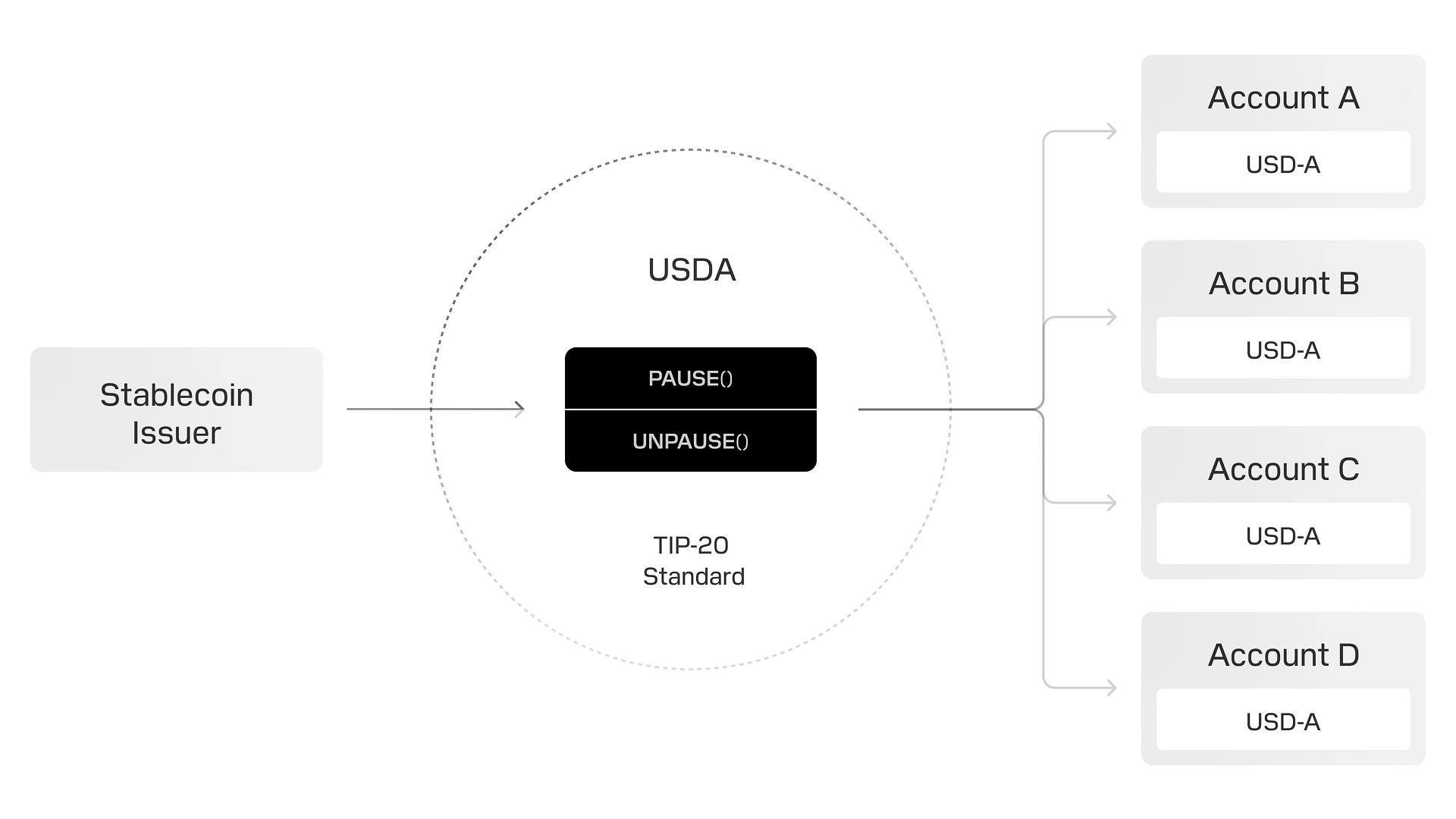
Tempo’s native token standard, TIP-20, includes built-in functions for emergency response and regulatory compliance. All TIP-20 stablecoins on Tempo support three functions: pause and unpause to halt and resume transfers, and burn to remove tokens from blacklisted addresses. Institutions can delegate access to these functions across teams using role-based access controls, providing a full onchain audit trail.
Tempo Policies
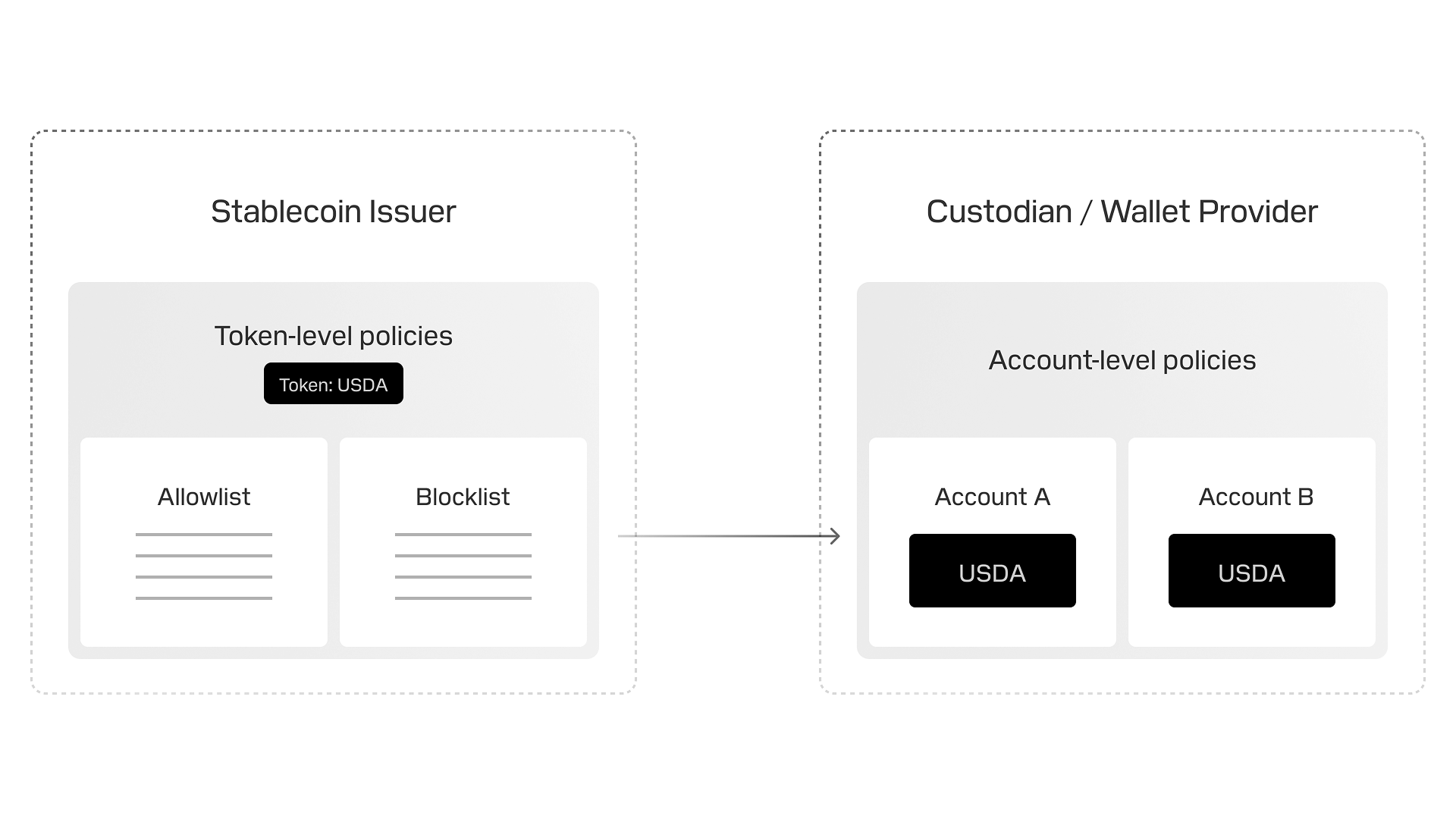
Tempo Policies complement TIP-20 functions by defining transfer rules at the token level. Tempo supports two policy types: allowlist policies and blacklist policies. These policies define which addresses can or cannot interact with a token.
- Token-level policies are managed by stablecoin issuers and apply globally across all holders. Policies can be shared across multiple tokens, enabling consistent enforcement.
- Tempo will soon support account-level policies, enabling separation of responsibilities between stablecoin issuers and custodial wallet operators. These will be managed by institutions operating custodial wallets and will apply to individual accounts, including send and receive policies to control which addresses an account can transact with, and token policies to control which tokens an account can receive.
Transfer memos
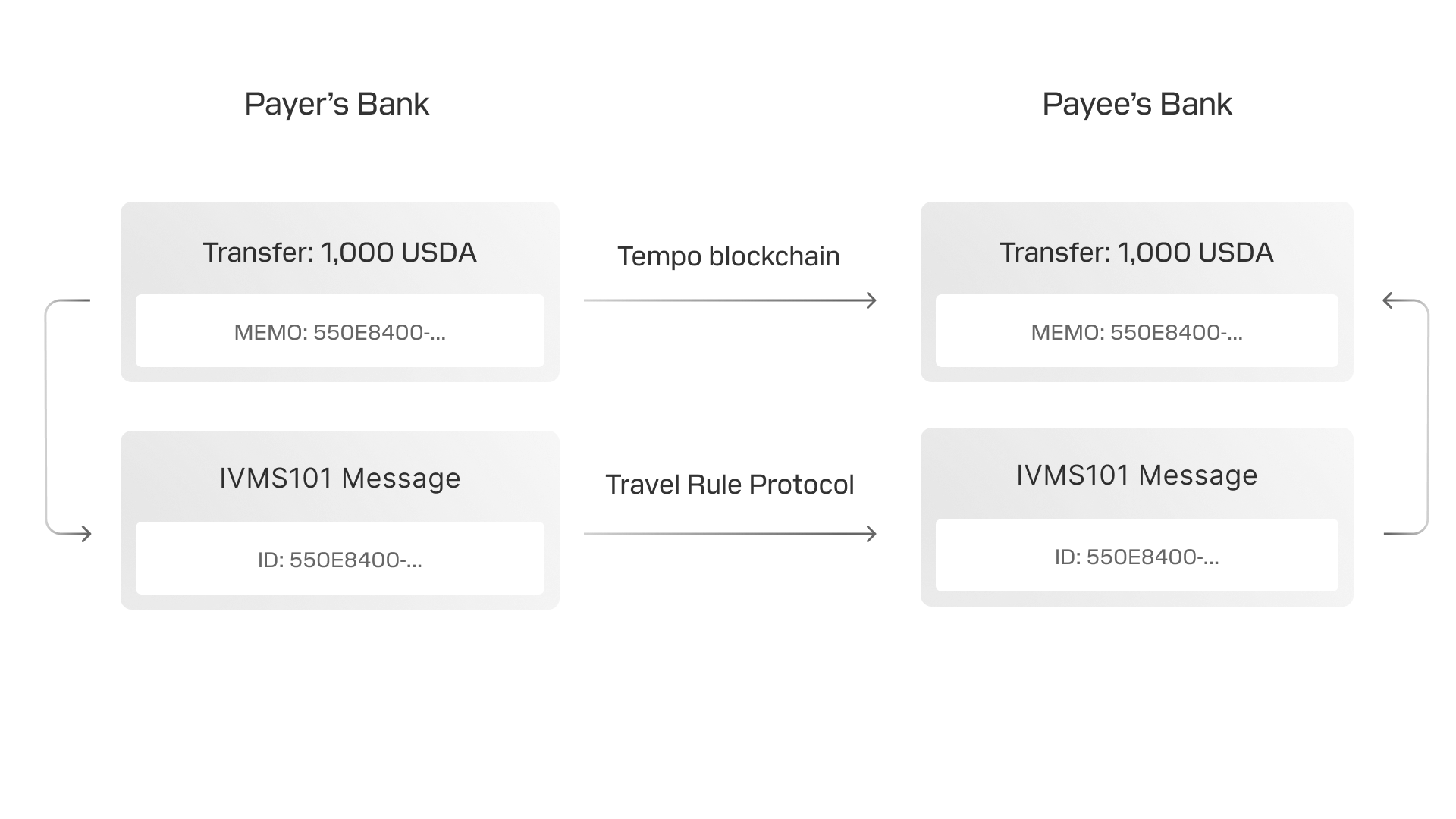
Transfer memos enable Travel Rule compliance by allowing senders to attach references to messages exchanged via industry protocols. Tempo natively supports 32-byte transfer memos attached to any transfer. These can reference IVMS101 or SWIFT messages. Receivers can use these references to match onchain transfers with the corresponding compliance data.
In an exam, regulators don’t ask whether you had alerts. They ask what you did about them. Who had authority to act? How quickly did they move? Can you show a clear record of the decision? Compliance teams carry that accountability. If enforcement sits outside the asset layer, response slows down and risk compounds. Controls have to live where the value moves. That’s what makes them real.
— Soups Ranjan, CEO & Co-Founder, Sardine
How institutions use compliance controls
Tempo’s compliance controls address several regulatory and operational requirements:
- Sanctions and freezing. Blacklist policies allow issuers to prevent sanctioned addresses from interacting with a stablecoin. When an address is added to the blacklist, it can no longer send or receive tokens, effectively freezing the funds in place.
- Custodial wallet restrictions. Once account-level policies are available on Tempo, custodians will be able to restrict a wallet to a specific set of approved addresses, or limit which tokens a wallet can hold. For custodians, that means the ability to enforce KYC-based allowlists, block sanctioned addresses, and reject spam tokens, all without relying on the token issuer.
- KYC-gating. Allowlist policies enable stablecoin issuers to restrict transfers to users who have completed KYC verification. Only addresses on the allowlist can send or receive the token, ensuring that the stablecoin circulates only among verified users.
- Asset recovery. When regulators or law enforcement request the seizure of funds, issuers can blacklist an address and burn tokens from it. This maintains a clear onchain record while satisfying legal requirements.
- Emergency response. Issuers can halt all transfers of a token in response to a security incident, regulatory request, or operational emergency using the pause function. Once the situation is resolved, the unpause function resumes transfers.
At Blockaid, we are excited to partner with Tempo to bring security & compliance to Tempo’s ecosystem. Blockaid offers a comprehensive real-time security platform that protects institutions and consumers alike from three onchain risk vectors - security vulnerabilities, sanctions / AML risk, and fraudulent transactions.
— Ido Ben-Natan, Co-founder & CEO, Blockaid
Start building on Tempo
Whether you are issuing stablecoins or building custodial wallets, we can help you get started:
Learn the fundamentals
Visit the Learn section of the Tempo documentation to understand stablecoins, how they work, and the payment use cases they enable.
LearnStart building
If you're familiar with blockchain development, head to our docs to connect to Tempo, access test funds, download SDKs, and start building with Tempo Transactions.
Read the docsMove faster with partners
You can also work with our infrastructure partners including Crossmint, Fireblocks, Privy, and Turnkey, who are rolling out Tempo Transactions and can help accelerate your development timeline. Visit the Ecosystem section to explore Tempo's growing network of partners.
Explore ecosystemFor guidance on implementing compliance controls for your use case, reach out to our Enterprise Team.
Frequently asked questions
What does the article say about Design principles?
For institutions, code must support the law. When designing Tempo's compliance capabilities, we focused on four priorities.
How compliance controls work on Tempo?
Compliance controls on Tempo consist of three components: TIP-20 functions, Tempo Policies, and Transfer Memos.
What does the article say about TIP-20 functions?
Tempo's native token standard, TIP-20, includes built-in functions for emergency response and regulatory compliance. All TIP-20 stablecoins on Tempo support three functions: pause and unpause to halt and resume transfers, and burn to remove tokens from blacklisted addresses. Institutions can delegate access to these functions across teams using role-based access controls, providing a full onchain audit trail.
What does the article say about Tempo Policies?
Tempo Policies complement TIP-20 functions by defining transfer rules at the token level. Tempo supports two policy types: allowlist policies and blacklist policies. These policies define which addresses can or cannot interact with a token.