Privacy with Tempo Zones
How Tempo Zones keep transactions private while connecting to public infrastructure on Tempo Mainnet.
By Liam & Varun
Introduction
People expect payments they make and receive to be private. A payroll company, for example, should be able to pay contractors without disclosing the amount publicly. This is challenging on blockchains since activity is public by default and tied to pseudonymous addresses. If an address is connected back to a person or entity, their entire history becomes publicly known.
Tempo Zones address this problem with private execution environments that connect to Tempo Mainnet. Users can move funds into Zones to keep their transactions private, while still taking advantage of public infrastructure on Mainnet like bridges, vaults and exchanges. Transactions inside a Zone are visible to their participants and the Zone operator, but are private from the public.
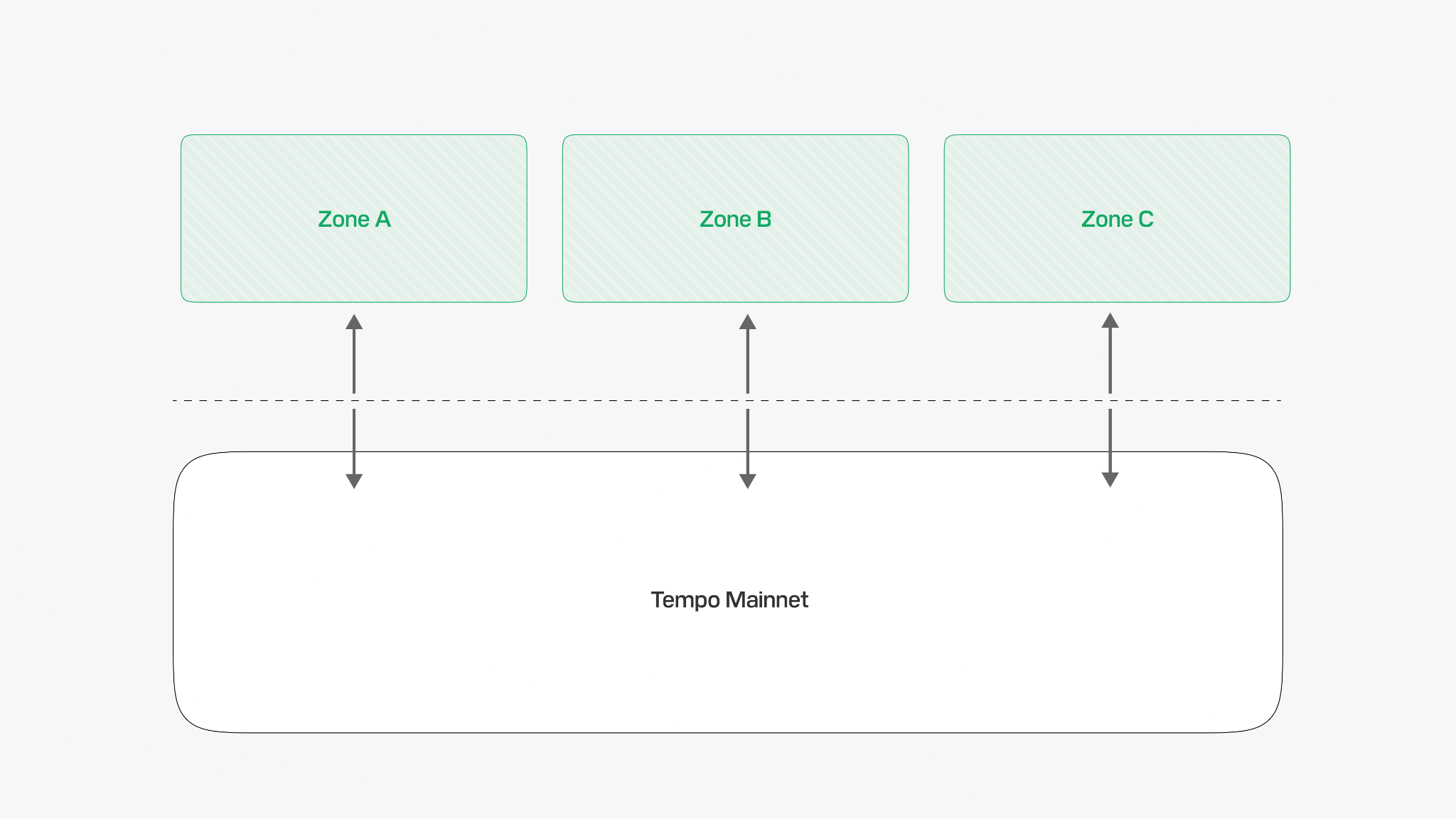
High level architecture
People often have trusted counterparties to financial transactions. For example, when receiving payroll people expect the business to be aware of how much they’re getting paid. Zones build on this trust boundary, giving users strong privacy guarantees and relying on the counterparty to run infrastructure to keep the transactions private.
Each Zone is a private execution environment run by an operator, which might be the payroll company in the example above. The operator runs sequencers, produces blocks and keeps all transaction data in their zone confidential. The operator has visibility into all balances and transactions and controls transaction ordering and inclusion into blocks. Users are only able to view their own balances.
The operator orders and executes transactions but cannot alter them or spend funds the user did not authorize. Operators must prove to mainnet that they executed transactions according to the rules of the protocol by producing a TEE proof, described in the prover section below. Mainnet accepts withdrawals from a Zone only after verifying this proof.
Funds are transferred into a Zone using a portal contract on Tempo Mainnet. A deposit to this contract locks tokens in the portal and credits an account on the Zone. Withdrawals do the opposite, burning Zone tokens and releasing deposits.
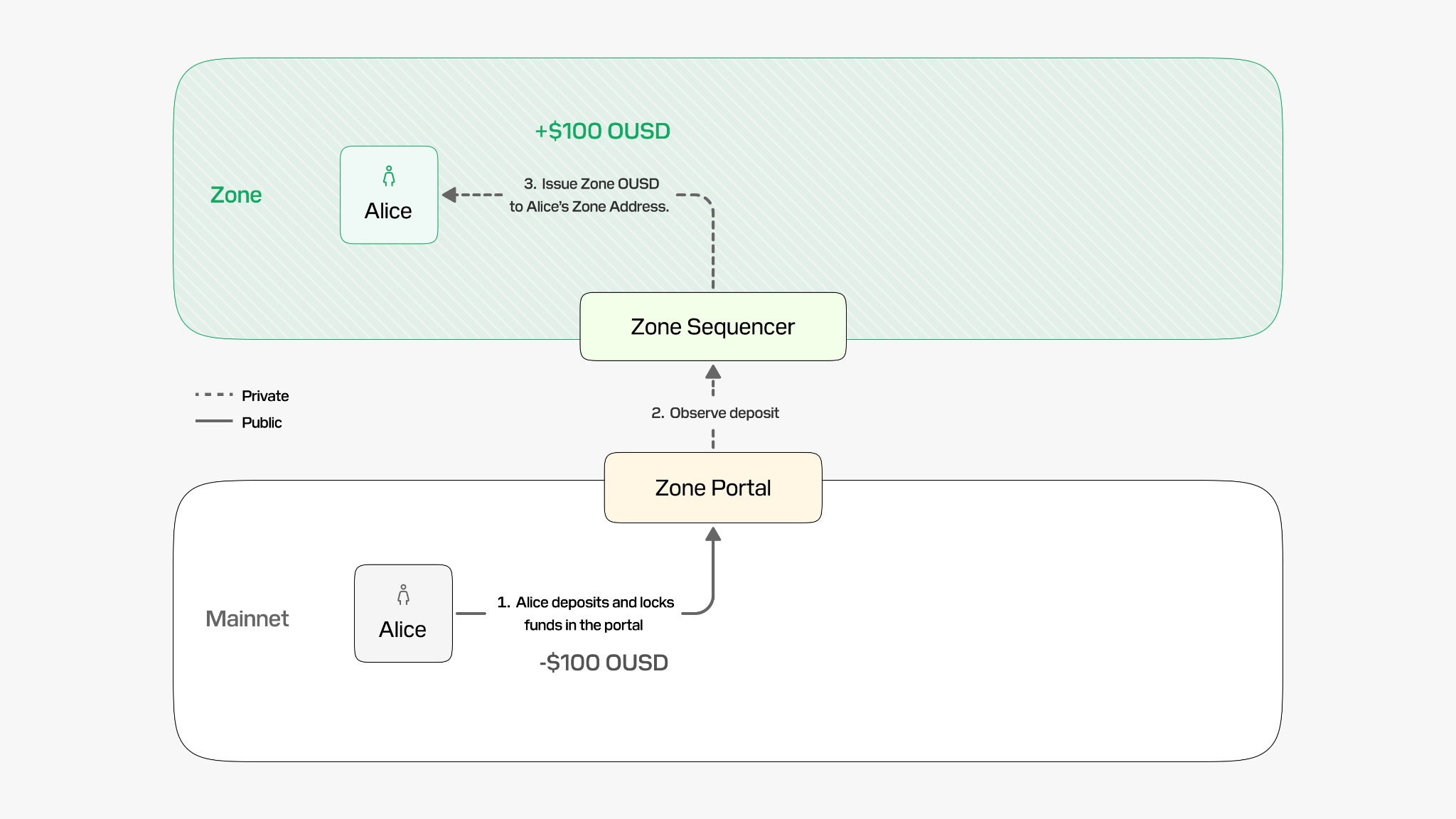
Privacy guarantees differ at each stage of a payment. On deposits, the destination address inside the Zone and the memo are encrypted while the sender, token amount, and destination Zone remain public. Within the Zone, transaction addresses, amounts, and timing are visible to the operator and participants, but not to the public. On withdrawals, a commitment hides the sender’s Zone address while the token amount and recipient remain public.
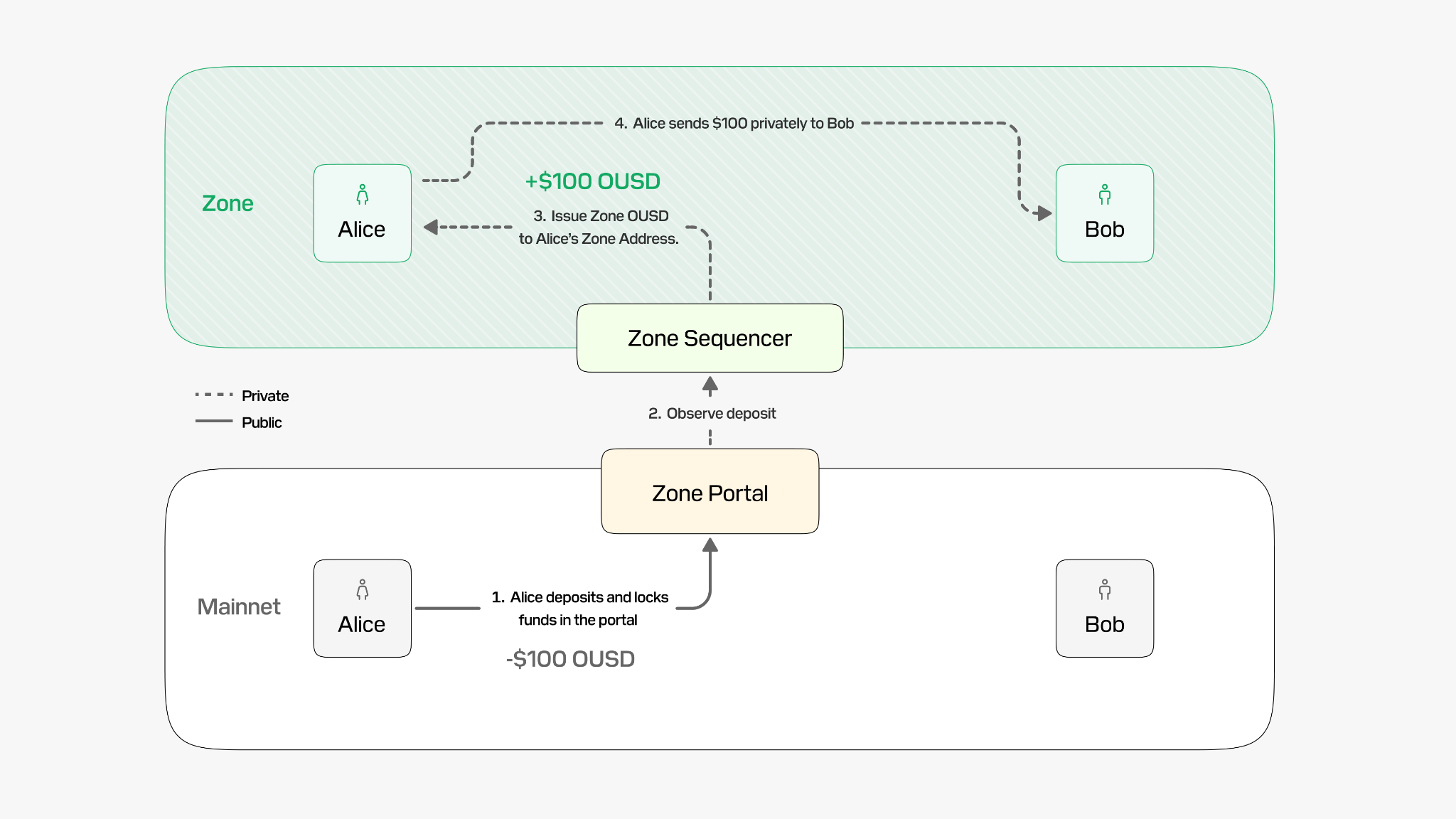
Making a private payment
Suppose Alice wants to pay Bob privately with OUSD but has funds on Tempo Mainnet:
-
Alice signs a transaction to send OUSD to the Zone’s portal contract and encrypts the destination address with the operator’s published encryption key so that it is not publicly readable.
-
The sequencer follows Mainnet and recognizes the deposit, verifies the chain state, decrypts the destination address and credits Alice’s address on the Zone.
-
Alice checks her balance through the Zone’s RPC endpoint, providing a signature to prove ownership of her account.
-
Alice then signs a transaction to transfer the funds to Bob’s address in the Zone.
-
The sequencer includes the transaction in the next block and transfers the tokens to Bob.
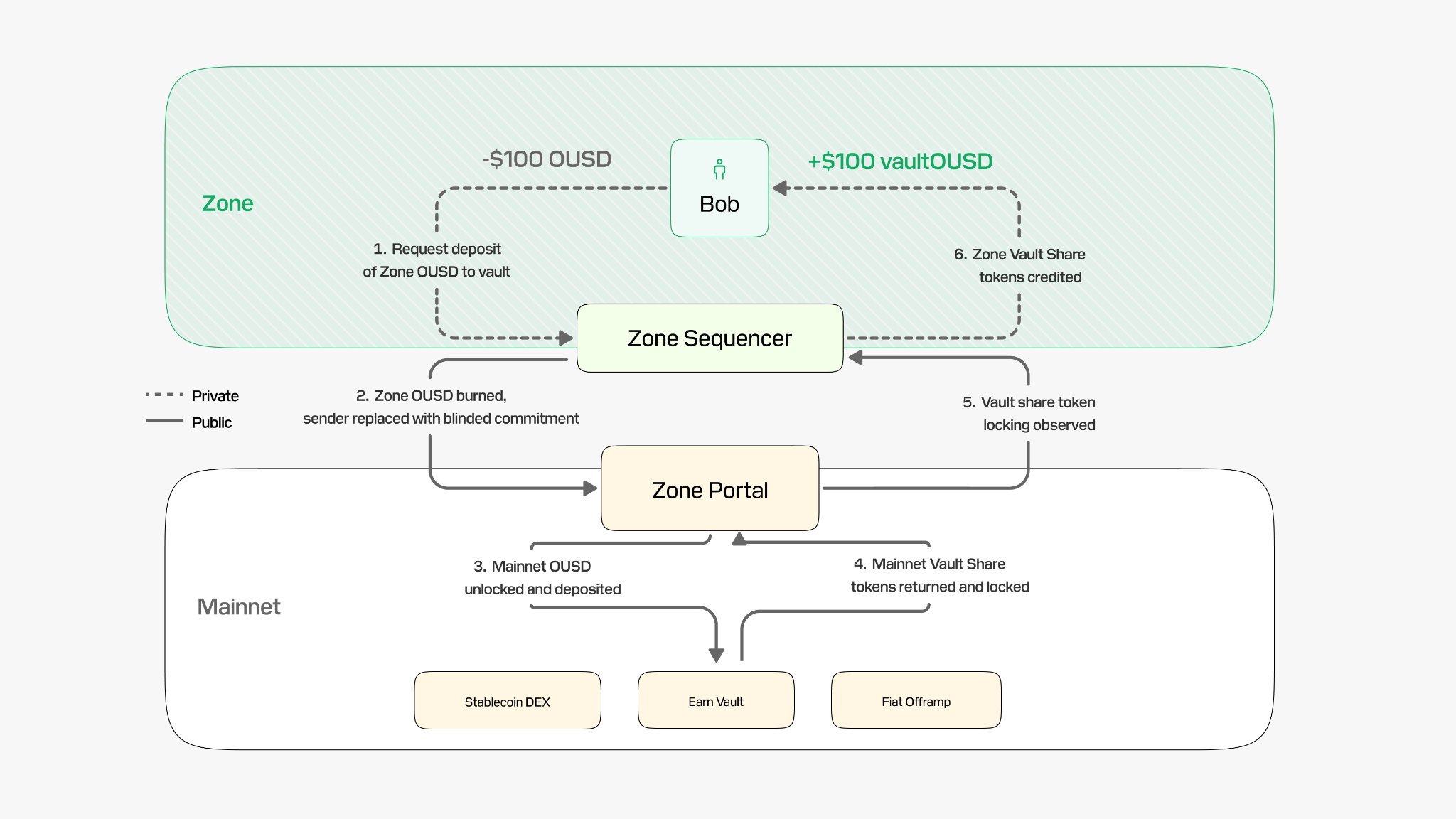
Interacting with mainnet while preserving privacy
Zones let users access exchanges, bridges, and offramps on Tempo Mainnet while keeping their transactions private. For example, Bob can deposit his OUSD privately from a Zone to a vault on Mainnet to earn rewards:
-
Bob submits a private Zone transaction instructing the sequencer to deposit his OUSD into a vault on Tempo Mainnet.
-
The sequencer executes the transaction and sends a message to the Zone portal on Tempo, using a blinded commitment instead of Bob’s address.
-
The portal deposits the funds into the vault through a router contract and receives vault tokens mapped to the blinded commitment.
-
The Zone operator now reads the new state from the portal, decodes the blinded commitment and credits Bob with the vault shares in the Zone.
Bob can also selectively disclose his identity to a Mainnet recipient such as an offramp that needs to verify his identity before allowing him to move funds into a bank account.
Verifying Zone transactions
Each Zone must demonstrate that its ledger was updated according to the protocol’s rules. This ensures that operators cannot misappropriate user funds, which always remain under the control of the user. The proving system works as follows:
-
The Zone operator prepares a witness with the new transactions, starting state and cryptographic proof needed to validate and replay transactions.
-
The Zone’s prover replays the witness inside a trusted execution environment, checking transaction authorization and execution rules.
-
The prover then produces an attestation binding the batch result to the Zone and the approved prover code that ran in the TEE.
-
Mainnet verifies the attestation before accepting the state update and withdrawals from the Zone.
Proving establishes that a batch follows the protocol’s execution rules, subject to the enclave’s security guarantees. Zone provers run inside AWS Nitro Enclaves, which are TEE’s that isolate execution and provide an attestation that lets Mainnet authenticate the prover’s execution. This gives Zones a practical, high-performance way to prove execution to the rest of the world. This proving architecture allows Zones to support different proving systems over time, including SNARK and STARK based proofs.
Forced withdrawals
Forced withdrawals allow users to submit withdrawal requests directly on Mainnet. This acts as a failsafe if an operator decides to ignore withdrawal requests from an address. Each request encrypts the Zone address, recipient, and authorization signatures while the token amounts remain public, as with regular withdrawals. Tempo Mainnet requires that the operator import and process the request before the Zone can advance its state.
Developer experience
Zones are designed for compatibility with the existing developer ecosystem. Developers can use familiar RPC endpoints, adding authentication signatures to access private data. Wallet providers such as Privy support Zones natively, so developers can get started with the wallets, APIs, and interfaces they already use.
Enterprise controls for Zones
Enterprises can configure their Zones to support specific customers, assets, and workflows, aligned with their compliance requirements. For example, a payroll provider might limit participation to its customers and contractors, while enabling only the stablecoins it uses for payments. Businesses may want to screen incoming deposits and apply address restrictions at these boundaries.
Operators can modify the Zone configuration to only support specific assets and access permissions. They can also use TIP-403 policies to enforce transfer rules and import existing compliance logic from Mainnet. Operators can also configure a closed-loop Zone that supports a limited set of wallets, such as omnibus accounts, and restricts access to external contracts.
Conclusion
Zones let businesses and users transact on Tempo with strong confidentiality and privacy guarantees. The Zones codebase is open source and can be reviewed today.
We’re working closely with our first customer to bring privacy to real-world payouts and will announce our first Zone soon, allowing users to privately deposit funds and earn rewards from Mainnet vaults. Over the next few weeks, we plan to integrate the prover, forced withdrawals and general transfers between accounts. Contact our team for early access to Zones.
FAQ
When can we start using Zones?
Zones are still in closed access for the next few months. The first Zone will go live in October for one of our customers. Get in touch if you’re interested in deploying one.
Who runs the Zone? Can we run our own?
Tempo provides fully hosted Zones, but the software is open source and we can help you run one on your own infrastructure. Running your own Zone involves additional integration work with wallet providers and other services, which we’re working to make easier.
What does it cost to run a Zone?
Operating a zone requires a sequencer node, rpc nodes and nitro prover. It is also recommended to have multiple instances for high availability. The approximate cost of running multiple instances of all these services is about $5,000 a month with high availability. Contact us if you’re interested in discussing pricing, we also offer hosted zones on our infrastructure.
Who can see activity inside a Zone?
Users can see transactions and balances pertaining to their addresses and the operator can see transactions and balances globally. Users can also choose to delegate permissions to a service provider (e.g. a wallet service) to fetch information on their behalf. Note that this access does not give them permission to spend or control users’ funds.
What changes when integrating Zones into an existing wallet or application?
Zones use familiar transaction-signing flows and RPC methods. Providers like Privy support Zones as first class primitives in their wallet APIs.
For direct integrations, applications connect to the Zone’s RPC endpoint and include a signed authorization token to access private data. Responses are scoped to the authenticated account.
What information remains public when funds enter or leave a Zone?
A deposit exposes its Mainnet sender, token, amount, destination Zone, and transaction timing. The recipient’s Zone address and memo are encrypted.
A withdrawal exposes its Mainnet recipient, token, amount, and timing, while a commitment hides the sender’s Zone address.
Can users withdraw without the operator’s permission?
In the initial deployment, withdrawals depend on the operator processing them. We’re building forced withdrawals so users can submit requests directly on Mainnet. The Zone would then have to process those requests before advancing its state. Recovery when an operator stops entirely requires a separate mechanism, which is also under development.
What fees apply, and who pays them?
Internal transactions incur Zone execution fees defined by the operator. Deposits and withdrawals also involve Mainnet transaction fees. In practice, these are less than $.0001 USD per transaction. Contact us for more specifics on fee structures for using zones today.
Can we make activity on existing accounts private?
Existing wallets can move assets from Mainnet into a Zone through a deposit. Subsequent activity inside the Zone is private, but moving funds into a Zone does not hide their previous public transaction history.
How secure are TEEs?
TEEs isolate sensitive computation and provide cryptographic evidence of the code that ran, with security that depends on the underlying hardware and software. 1Password, Fireblocks, and Privy already use AWS Nitro Enclaves (a popular and reputable TEE) in deployed products, while Apple uses its own secure hardware architecture for Private Cloud Compute.
What happens if the operator goes offline?
We are designing a mechanism to allow recovery of funds if the operator goes offline for an extended period of time, and will have more to share about this soon.
Can I deploy smart contracts to a zone?
No, zones are currently designed only to support payments by transferring tokens. Interactions with smart contracts require bridging back to Tempo Mainnet. This has two benefits – it keeps the surface area of zones contained and easy to secure and ensures liquidity pools on mainnet where it can be accessed by multiple zones.
Why did you pick AWS Nitro over other approaches to proving?
AWS Nitro provides an isolated execution environment and remote attestation for stateless proving. The prover design is independent of Nitro, giving Zones the flexibility to support other proving systems in the future.
Can funds move between Zones operated by different businesses?
The protocol supports transfers between Zones through Tempo Mainnet. Funds withdrawn from one Zone can be deposited directly into another, with the destination account kept private. Both Zones must support the asset, and the transfer must meet their access rules and the token’s policies.
What happens if a vault deposit, swap, or withdrawal fails from a Zone?
If a withdrawal initiated from a Zone fails on Tempo Mainnet, including when a swap or vault deposit callback reverts, the callback’s effects revert and the funds are queued to return to the Zone at the fallback account specified in the withdrawal.