Virtual addresses for stablecoin deposits
Virtual addresses on Tempo give exchanges, ramps, neobanks and financial institutions unique deposit addresses for every customer without the overhead of sweep transactions. Funds sent to a virtual address are credited directly to a registered master wallet at the protocol layer. Contact us if you are evaluating how to streamline stablecoin deposit flows.
Every payments company runs into the same deposit problem: offering customers unique recipient addresses makes reconciliation easier, but managing these addresses at scale is expensive. If you issue a unique address to each customer, merchant, or invoice, you also inherit the work of sweeping funds, monitoring balances across thousands of endpoints, and managing a much larger wallet surface area.
For enterprise teams, that overhead shows up in more complex ledger logic, more treasury operations, more transactions to pay for, and more chances for funds to get stuck between "received" and "available."
Why deposit addresses get expensive
Consider a neobank that provides each user with a unique address to fund their account. On most chains, a deposit address is a real account. At scale, that creates several problems.
First, funds land in the deposit address itself. On some chains, you need to pay a certain amount ("state rent") to initialize an account to receive funds, which can be cost-prohibitive at scale.
If your treasury wallet needs consolidated funds, you have to sweep those balances out with separate transactions. That adds latency, gas costs, and failure modes.
This also adds infrastructure overhead for the network and for the applications that need to monitor and reconcile those accounts. Support, finance, operations, security and compliance teams all need to understand where funds landed, when they moved, and whether that movement was expected.
Introducing virtual addresses
Virtual addresses are now live on Tempo. A virtual address looks like a normal address to the sender, but it is not a standalone wallet that needs to hold or sweep funds.
A business registers a master wallet once. After that, it can derive trillions of customer-specific virtual addresses offline. When a sender transfers a TIP-20 stablecoin to one of those addresses, Tempo detects the virtual address format, resolves it to the registered master wallet, and credits the master directly.
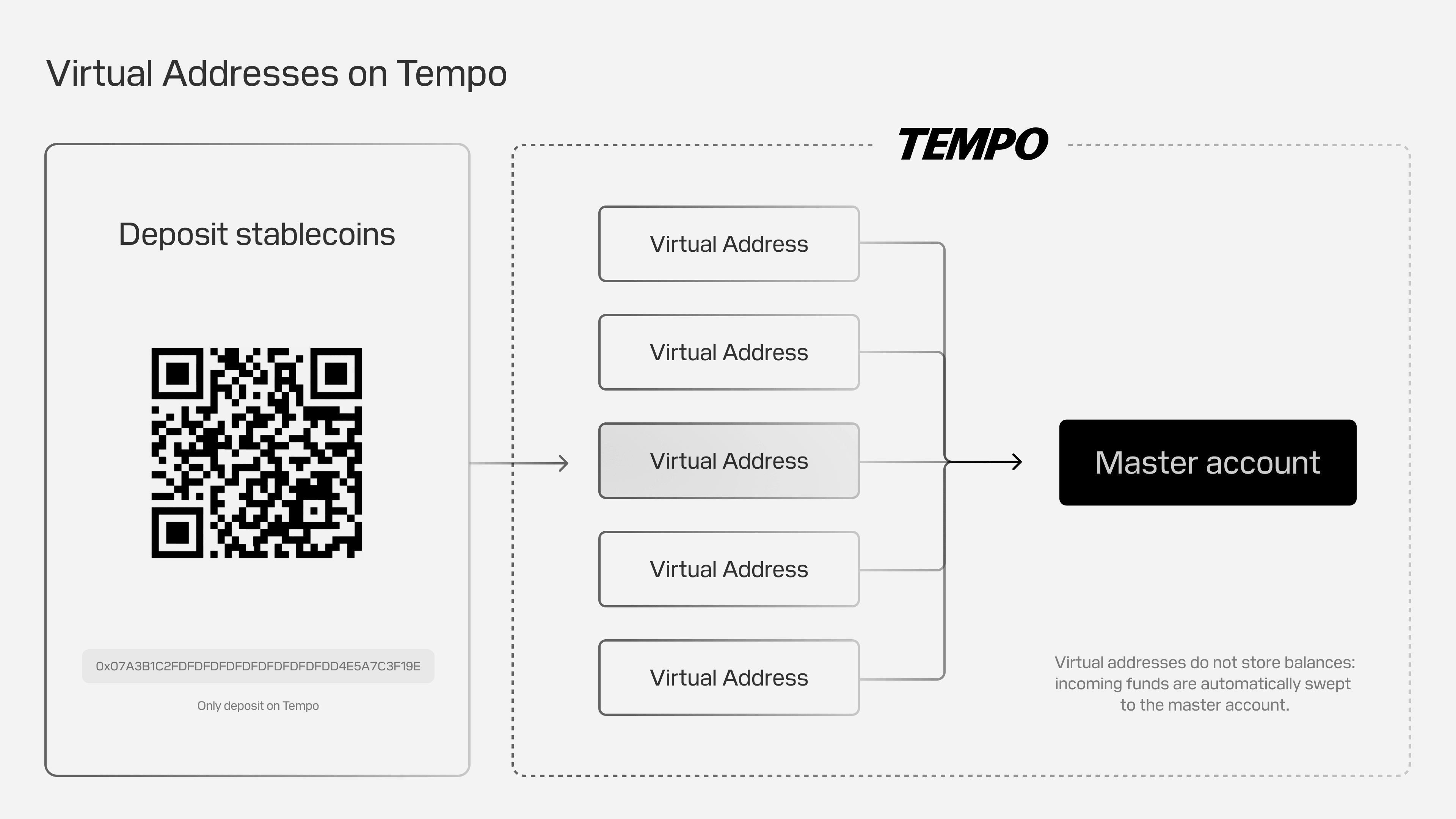
As a result, the sender still has a unique address to send to, while the operator receives funds in one real wallet without a sweep step in between.
Virtual addresses are especially useful for businesses that receive stablecoin payments at scale:
- Exchanges and brokers issuing dedicated deposit addresses
- Onramps and offramps attributing inbound customer funds
- Marketplaces that need one address per merchant or invoice
- Treasury platforms that want segmented inbound payments
In each case, the business need is the same: accurately attribute the payment to the intended recipient, while holding the funds at rest in a single address.
Why virtual addresses matter for enterprise teams
Virtual addresses are not an application-layer forwarding workaround. They are built into how Tempo handles TIP-20 transfers, and offer a native solution to the reconciliation challenge without the complexity that typically comes with creating separate onchain accounts for each customer:
- Straightforward customer attributionEach virtual address can still represent a specific customer, merchant, corridor, or payment flow. You keep the reconciliation benefits of unique deposit endpoints without turning every endpoint into another wallet your team has to manage.
- No sweep operationsFunds arrive where your business actually wants to manage them. There is no second transaction to move assets out of a deposit address and into a treasury wallet. That reduces latency, lowers transaction overhead, and removes an entire operational workflow.
- Lower infrastructure overheadVirtual addresses do not create separate onchain accounts for each recipient. That means no new-account cost for every deposit endpoint you issue.
Sponsor banks let fintechs issue virtual accounts to their users. Virtual addresses serve as the onchain analogue of those accounts. Combined with subscriptions and MPP Sessions, they give platforms a complete deposit-and-billing stack on stablecoins.
Work with Tempo
If you're building deposit flows, merchant settlement, exchange funding, or payout infrastructure, virtual addresses can remove a meaningful amount of operational overhead from your stack.
Tempo's enterprise team can help evaluate whether virtual addresses fit your payment flows, map them into your ledger and reconciliation systems, and support a pilot with the right partners.
Virtual addresses are part of a broader set of new enterprise features live on Tempo today. For the full picture, see new features on Tempo for enterprise payments.
Read the documentation or contact our enterprise team to explore virtual addresses on Tempo.