New features on Tempo for enterprise payments
Tempo is purpose-built for global payments at scale. Today we're shipping new capabilities that make more enterprise payment workflows work natively on stablecoins: subscription billing and auto pay through enhanced access keys, and per-customer deposit attribution, invoice-level reconciliation, and multi-tenant wallet structures through virtual addresses. All live on mainnet. If you're evaluating any of these workflows, our Stablecoin Advisory team can help you scope the use case and get to production at tempo.xyz/contact.
Tempo is a payments-first blockchain, built to give enterprises the rails they need to move money globally on stablecoins. Last week we launched Stablecoin Advisory and introduced the first wave of enterprises going live on Tempo. Today we're adding new capabilities to the network that bring more of the payment workflows enterprises run every day onto stablecoins.
Stablecoin infrastructure has made one-time global payments practical, but the recurring flows, attribution challenges, and multi-tenant wallet patterns that make up the rest of enterprise payment operations have been harder. New features on Tempo close those gaps.
Recurring payments with enhanced access keys
Recurring billing on stablecoins has forced a tradeoff that neither option handles well. Businesses have had to either re-prompt users at every charge, which breaks the subscription model, or ask users to pre-authorize significantly more funds than they actually need, which degrades the user experience and increases risk for the consumer.
Enhanced access keys remove that tradeoff. A user authorizes a per-period cap once, for example $50 per week for 52 weeks, and the service charges on schedule within that limit. The cap resets automatically when the period ends, and the user can revoke the authorization at any time. Access keys can also be scoped to a specific contract, so a key authorized for one service cannot be used to interact with anything else.
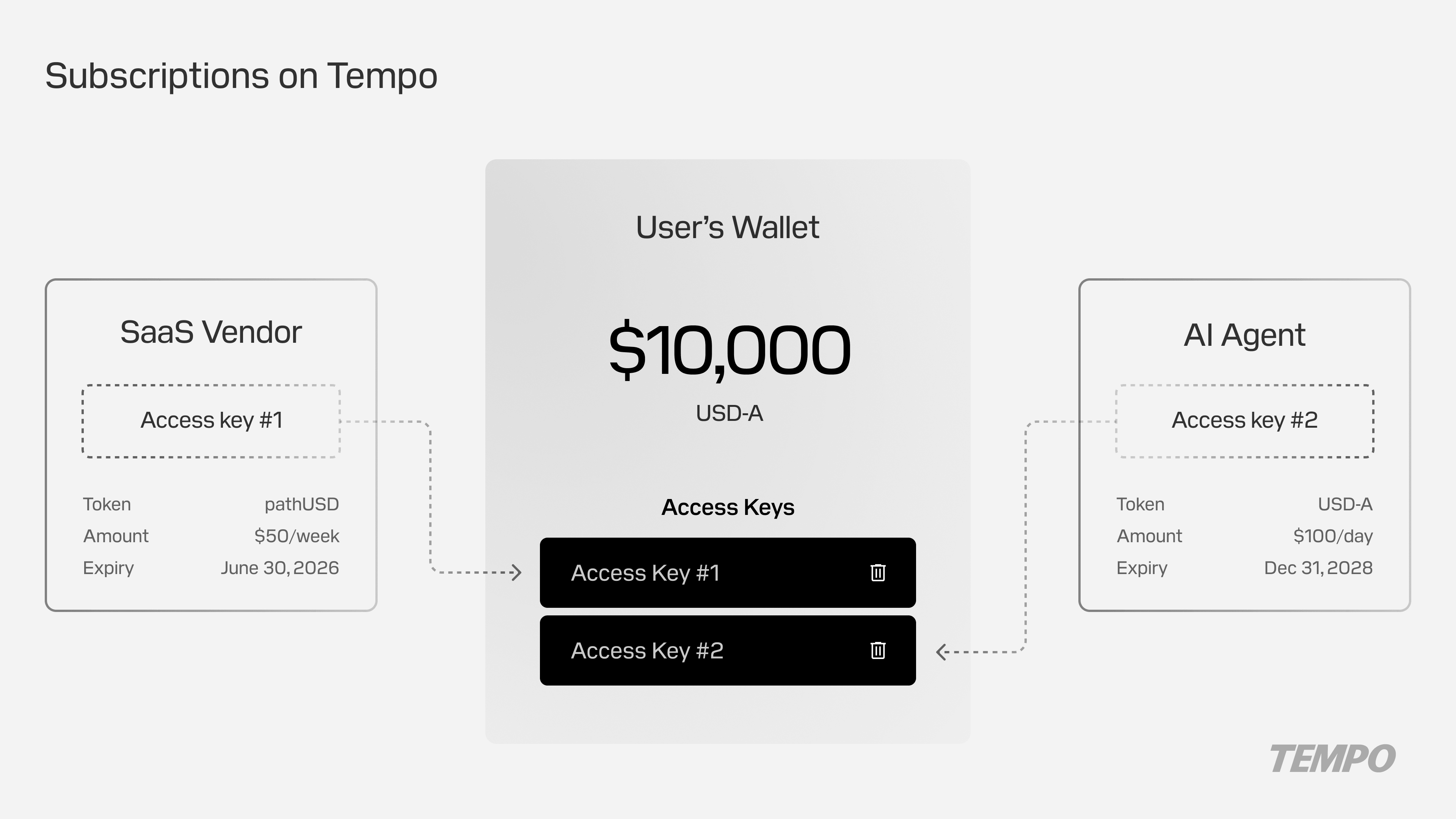
This makes several common enterprise billing patterns practical on stablecoins for the first time.
Subscription billing
SaaS companies, streaming services, and any business with a fixed recurring charge now have a native stablecoin path. A subscriber authorizes an access key once, and the service charges on the same schedule across every country the business operates in, with instant settlement and no regional payment integrations to maintain.
Auto pay
The same primitive enables auto pay for recurring obligations. Utility bills, rent, loan servicing, and any recurring business obligation can be paid on a schedule by authorizing a per-period cap to the payee. The pattern is functionally similar to ACH debits in traditional banking, with the difference that settlement is instant, the authorization is programmatically scoped to a specific payee, and the user can revoke at any time without contacting the payee.
Metered and usage-based billing
For services that charge variable amounts per period, access keys also support usage-based billing. A customer authorizes "up to $500 this month," and the service charges based on actual usage, whether that's API calls, compute time, data access, or throughput. The ceiling protects the customer, the recurring authorization simplifies operations for the service, and neither side has to manage prepaid credits or handle overage surprises.
Customer deposits and platform wallet structures with virtual addresses
Every business that holds customer funds runs into the same problem. Giving each customer a dedicated deposit address makes reconciliation tractable and matches how fintech platforms have always structured customer money. Managing those addresses at scale is expensive, because on most chains every deposit address is a real onchain account that has to be initialized, monitored, and swept into a treasury wallet with additional transactions. At scale, that becomes operationally prohibitive.
Virtual addresses solve this at the protocol layer. A business registers a master wallet once, then derives unique customer-specific virtual addresses offline. Deposits sent to any of them credit directly to the master wallet with no sweep step in between and no per-address initialization cost. The sender still has a unique address to send to, and the operator receives funds in one consolidated wallet.
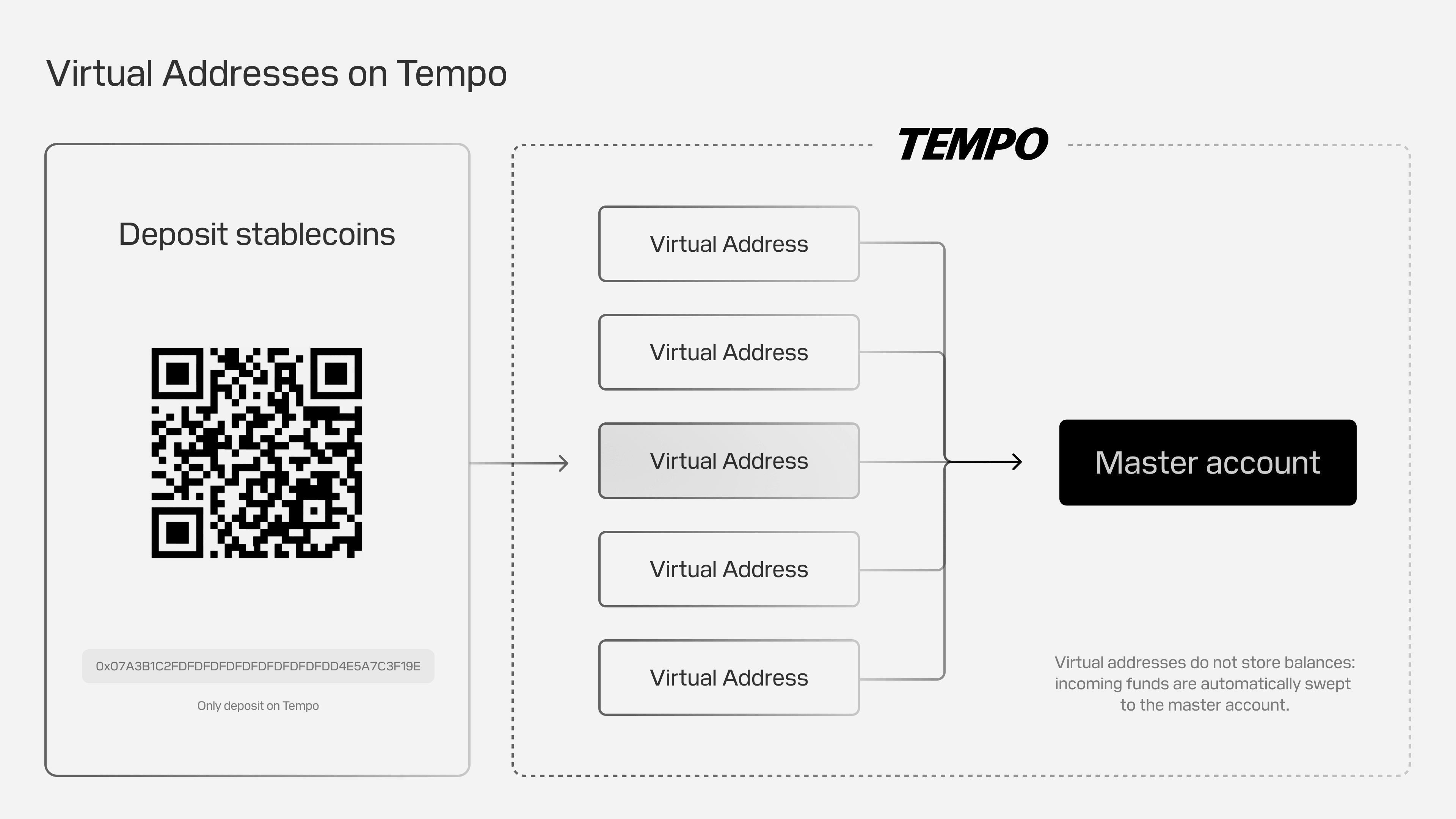
Per-customer deposit attribution
For exchanges, neobanks, ramps, and custodians, virtual addresses deliver per-customer deposit attribution without the infrastructure tax. Every customer gets a dedicated deposit address that represents them specifically, inbound payments are attributed automatically, and operators keep the reconciliation benefits without the operational overhead of managing thousands of onchain wallets.
Invoice-level reconciliation
The same primitive enables invoice-level reconciliation for marketplaces and billing platforms. Instead of one address per customer, operators can issue one address per invoice. Inbound payments match to invoices automatically on arrival, and finance teams get clean structured reconciliation data rather than manually matching senders to line items.
Multi-tenant wallet structures
Virtual addresses also support multi-tenant wallet structures for fintech platforms and embedded finance companies. Sponsor banks today offer virtual accounts to fintechs: one master account holds customer funds, with structured sub-accounts and managed balances per end user. Virtual addresses are the onchain analogue of that pattern. A platform can maintain one master wallet while giving every end user a dedicated virtual address, preserving the customer-level structure that platforms need to run their business, without the infrastructure cost of separate wallets per user.
The master wallet address is not directly exposed to senders, and each customer interacts only with their own virtual address. Virtual addresses work with TIP-20 stablecoins, and non-TIP-20 tokens sent to a virtual address may be lost.
Read more about virtual addresses
Getting started
Every capability described here is live on Tempo mainnet today. If you're evaluating stablecoins for subscription billing, auto pay, metered pricing, customer deposit attribution, invoice-level reconciliation, or multi-tenant wallet structures, Tempo's Stablecoin Advisory team can help you scope the use case, design the architecture, and support a pilot.
Read the documentation or work with us at tempo.xyz/contact.