Why stablecoin adoption will grow demand for tokenized deposits
Financial institutions are concerned that stablecoins will drain their deposits; however, the opposite is more likely. As more businesses get paid in stablecoins, treasurers will move idle balances into tokenized bank deposits, which count as cash on the balance sheet and support the company’s credit lines. Banks that let treasurers move money instantly between stablecoins, tokenized deposits, and tokenized money market funds will win that business. Explore tokenized deposits for banks.
The common concern is that every dollar moving into stablecoins comes out of a bank deposit account. During the debate over the GENIUS Act, a presentation to the Treasury Borrowing Advisory Committee put the deposits at risk as high as $6.6 trillion.
That estimate assumes businesses leave their stablecoins sitting in a wallet. However, corporate treasury teams already move idle cash into interest-bearing accounts and money market funds, and they will want to do the same with stablecoin balances.
Why treasurers prefer bank deposits
For a bank's corporate customers, deposits are at the core of the banking relationship. They lower the fees a company pays for payments and cash management, and they give it access to credit lines, overdrafts, and intraday liquidity.
When we work with fintech and enterprise clients that launch stablecoin accounts on Tempo, a return on customer balances is often one of the first features they ask for after launch. Platforms offer it through Earn programs, where the yield usually comes from DeFi lending protocols or tokenized alternative credit funds.
For corporate customers, the yield will come from tokenized deposits or money market funds instead. Deposits count as cash and money market funds as cash equivalents, so both count toward liquidity ratios and cash-based loan covenants. Most stablecoins don't qualify yet, and corporate investment policies often require board approval to hold them.
What tokenized deposits are
A tokenized deposit is an ordinary bank deposit recorded and moved on a blockchain. The claim stays a liability of the bank, can earn interest, and can support credit facilities. Banks issue tokenized deposits in two main forms:
- Tokenized depositsThe bank's core system stays the final record, and the blockchain is a programmable layer on top. Clients can send payments at any time, but settlement still follows the core's cycles. Most live programs work this way.
- Deposit tokensThe blockchain is the authoritative record, so a token transfer moves the claim itself, and instruction, settlement, and posting happen at once. The recipient doesn't need an account at the issuing bank.
A company that gets paid in stablecoins can swap into a tokenized deposit when a payment arrives and earn interest until it needs the money for outgoing payments.
To learn how banks can structure tokenized deposits and which models are already live, read Tempo's primer, Tokenized Deposits for Banks.
How this works for a corporate treasury
Take a US distributor that sells to buyers in Brazil, Nigeria, and Vietnam. When those buyers pay in OUSD instead of sending a cross-border wire, the money arrives faster and at lower cost, at any hour, including weekends. The distributor pays its own suppliers every Tuesday and Friday, and some of them now ask to be paid in stablecoins too.
Today the distributor has to choose between leaving the OUSD in a wallet or offramping it to dollars. Offramping means waiting for banking hours for the fiat leg to settle, and converting back later to pay the suppliers who want stablecoins.
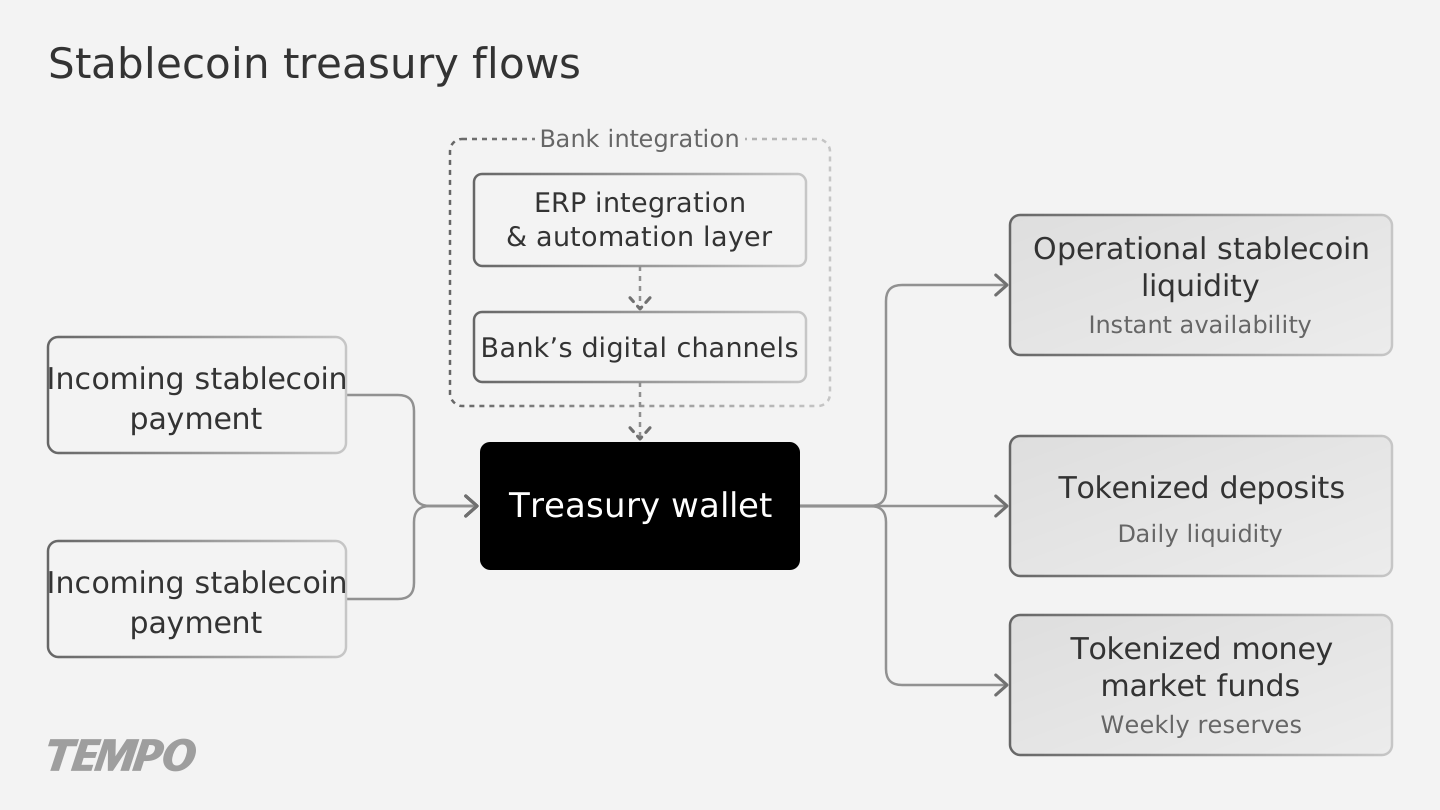
If its bank offers tokenized deposits, the distributor can swap each OUSD payment into a tokenized deposit as soon as the payment arrives. The balance counts as cash on the distributor's balance sheet and earns interest at the bank until the next supplier run, when the treasury system swaps it back into OUSD and pays the suppliers.
The bank can also win the outgoing payment flow. If it onboards the suppliers who ask for stablecoins, the distributor can pay them in tokenized deposits directly, without converting back into OUSD, so the money stays on the bank's balance sheet end to end.
What tokenization adds
Three properties make tokenized deposits and money market funds work better than a traditional sweep account:
- Intraday interest accrualWith a traditional sweep account, cash that arrives after the daily cutoff earns nothing until the next business day. A token ledger records the exact time funds move in and out, which lets a bank pay interest by the hour.
- 24/7 availabilityA business can swap into and out of tokenized deposits and fund tokens on weekends and holidays, when bank wires don't run. Cross-border payments often arrive outside the banking hours of both the sender and the receiver, and the money no longer has to wait for Monday.
- Mobility between assetsA stablecoin, a tokenized deposit, and a fund token can be swapped for each other in seconds. These swaps are atomic, so both sides settle together or not at all, and the business carries no settlement risk while cash moves between a wallet and a bank account.
With these features, a treasury team can tailor its cash management to its own business needs. It can decide in real time how much cash to keep in stablecoins for upcoming payments and how much to move into tokenized deposits or funds, instead of waiting for end-of-day sweeps. It can also automate those decisions, for example by moving any balance above a set threshold into a tokenized deposit as soon as a payment lands.
The opportunity for banks
Banks can offer all three products. Stablecoins suit payments to and from customers and suppliers, tokenized deposits suit operating cash that needs to be available within minutes, and a tokenized money market fund suits larger balances that will sit for weeks. Making it easy to swap between them gives corporate customers a reason to keep their float with the bank.
Stablecoin adoption is an opportunity for banks to grow their deposit base. Treasury teams that adopt stablecoins now are choosing which providers will hold their idle balances, and they rarely switch once that setup is in place. Banks that offer tokenized deposits and tokenized funds early are in the best position to win those balances.
If you're a bank exploring tokenized deposits or stablecoin treasury products, get in touch with our team.